|
In the Spotlight
June 2006 |
|
| ||||
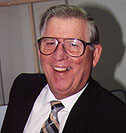
| This is the final article for "In The Spotlight" We appreciate John's labor of love over the last six years. He has been dedicated to Christian poetry and its expression. Month after month he has brought to our attention many special poems and the poets that authored them. We appreciate John and wish him well in all his future endeavors. Please continue to use his column as a great resource for your personal growth and pleasure. | ||||
|
| ||||
|
For My Darling We are told we are old, yellowed, sere,
darling, ¸,.-•~•~•-.,¸
joevans@comcast.net |
![]() John Evans |
Dear Friends and Contributors to the FOCP web site,
As some of you might not know, yours truly is now past 78 years in age (and
as the KJV suggests, I feel at times pretty "well stricken" in them), and my
wife Joyce is also beginning to feel more the weight of the number of her
years (of course I'll not say how many!); therefore I’m reporting that this
could well be my last "In the Spotlight" article. It's been a pretty
long--but surely enjoyable!--run for me since the founding of our fellowship
in Jacksonville in 1998, and it bodes to be a sad parting on my part, I
wanted to report this at the outset of this edition, as it colors the
content found here, obviously. I hope you will indulge me.
In addition to the above, some of you might know that my one and only wife
through the years--nee Joyce Runyan of Dayton, Ohio--and I are soon to
celebrate 54 years together in June, Lord willing. In anticipation of that I
wrote--with the hand of God especially upon mine, I felt--the poem you find
to your right, about which I've received, I believe, more favorable comments
than on any of my other efforts. The fact of my having been so blessed in
this marriage for all these years and wanting therefore to bless my wife,
together with the fact of the seeming special inspiration in the writing,
contributed to the choice to feature my poem you note here...
I should also say in the way of introduction to "For My Darling" that its
inspiration in a negative way comes from Lord Byron, noted English poet, who
wrote in 1824 an anniversary poem also, a birthday one, but a sad commentary
on his life (in contrast to my own, can I humbly say?). It’s titled, "On
This Day I Complete My Thirty-Sixth Year." It reads in part:
"My days are in the
yellow leaf,
The flowers and fruits of love are gone;
The worm, the canker, and the grief
Are mine alone."
Isn't that a sad, sad commentary on life, friends? To me it is one of the
saddest, because, probably, the poet somehow neglected The Greatest Gift in
life to enhance abundant living, and you know I speak of Jesus Christ, our
Lord and Savior, as that Gift. Also he no doubt had not been blessed to come
down the marriage altar to such a wonderful woman as God privileged me to
stand with before the officiating clergyman--and that is definitely sad
also. Insofar as his salvation is concerned, we can only hope that the poet
somehow turned his life around dramatically before his death--or, rather,
let Jesus Christ turn it around for him--as he would need to accept Christ
as his personal Savior and Lord to see a change effected.
Joyce and I in this life are physically "in the yellow leaf," as was Byron
at 36--but thankfully not in the spiritual sense, praise God! Like autumn
leaves we are well past our prime according to the flesh. However, as
suggested, we are in Christ's fold with all our four children, their
spouses, and most if not all our eleven grandchildren. We also have had
relative good health for our seventy-plus years, this no doubt because we've
not indulged in the prodigal life-style that history tells us was the poet's
noted above. We’ve tried through the years to walk "in the Spirit,”
believing that Christians live longer, on the average, because of the
advantages of the union of the flesh with the Holy Spirit. In l Timothy 4:8b
we read that...Godliness is profitable unto all things, having promise of
the life that now is, and of that, which is to come."
Anyway, friends, that "yellow leaf poem," in a secondary way, had its
influence on what you find here.
Perhaps I should say a bit more as to why I use my own poem above, since
I've never done this before since starting out, when I first was assigned
the column by our founder. It is because I believe God gave me the poem you
find here that I am so including it today; and let me say categorically that
I DON'T TURN THE SPOTLIGHT ON MY OWN WORK BECAUSE I THINK, AS SOMEONE ELSE
HAS BOASTED, "I'M THE GREATEST!" Frankly, I've remarked on other occasions
that I believe our English poet, David John of Oxford, England, and our own
Juanita DeHart of Houston, Texas, lead us all in the fellowship in the art
of writing poetry, to be perfectly honest with you. That is my personal
opinion, of course. However, I do believe that God did especially give me
some things to emphasize in this poem (together, again, with the fact I want
to honor my wife), which should be helpful to us all, and I want to draw
them to your attention now.
Having laid some groundwork, then, and having your indulgence, I hope, may I
say in the first place that I believe we should occupy our minds in the
reading of good poetry if we want to excel through the years in quality
writing ourselves. Lord Byron is recognized as one of the best poets in all
of English literature, notwithstanding his failures, and we should make such
good poetry as his an integral part of our reading enjoyment if we want to
excel in the medium. The portion of this poem of Byron's is an example of
the influence of others on our writing, and as it is true that we are a part
of all the people we have met, so as poets we are a part of all the good
poetry we have read as well. Nothing else, other than the Holy Spirit
Himself, can stimulate good poetry writing and the skills that accompany it
as this preoccupation with others' good works.
I think also that we should make use of apt figures of speech in our
writing, as, hopefully, my metaphors of "autumn leaves" and "frost," similes
such as "gold" and "fruit," and personification and synecdoche as in the
reference to God's "hand" coming down to deliver His own. Again, I feel God
was behind my inspiration to use these.
Alliteration might also be more employed by us in our poetry, I'd suggest.
With God's leading I’ve used "frayed by frost," "hallowed hand," "dear,
darling," "down, darling," ""golden good," and "winter's woes" as examples.
(There was a time in the past, you might like to know, when poets made this
almost the totality of the medium in their writing, to distinguish it from
prose.)
As for instances of inner assonance of sound, I've used with God's hand
especially on mine, again, "told we are old," "gold, mellowed," "beauteous
fruit," and "woes thus to go." The inner between-the-line harmonizing of
"yellowed” in line one, with "mellowed" in line three, and "sere," line one,
with "dear," line three, are innovating and pleasing, I believe also. These
harmonizings are noted apart from the usual end-of-line instances, common to
much of our poetic efforts, as it should be.
Of course it is a given that we as followers of Christ will have
scripturally-spiritual emphases in our works. "For My Darling," in its
spiritual content, would, I hope, illustrate such an emphasis.
Signing off I'll say it is plenty hot here in Florida for May. I hope and
pray that this is not tell-tale of another bad year with hurricanes in the
South and along the Atlantic coast. We've been spared here in this part of
Florida, for the most part, but do pray with us that America shall not be
battered and deluged again; that God in His mercy will spare us
Wherever you are, may you have an exceptional late spring and summer.
Until next time,
John Evans,
Jacksonville , Florida , USA
joevans@comcast.net
© 1998-2007 Fellowship of Christian Poets
This site is maintained by
WebTech Design Group
Christian Web Design,
Hosting, SEO and more
Visit them to see their low rates and Free Resources
To report a problem on this site, please contact them at:
support@webtechdg.com